
Like many hams around the world, I was excited to try my hand at decoding SSTV images from the international space station. The transmissions on 437.550 MHz in Robot 36 mode commemorated some great milestones: the 65th anniversary of Yuri Gagarin’s flight (Cosmonauts Day), the 100th anniversary of the first liquid-fueled rocket launch, the 45th anniversary of the first Space Shuttle flight, and the 20th anniversary of SuitSat. decided to keep things simple and see what I could pull off with portable gear. My station for this event consisted of a BTECH UV-Pro handheld and a basic mag-mount antenna in my backyard. No fancy tracking antennas, just the radio, my Android phone, and some patience.
The BTECH UV-Pro performed better than I expected for satellite work. The real star was the accompanying Android application. It has a built-in satellite mode that automatically handles Doppler shift correction as the ISS passes overhead. On 70 cm, Doppler is noticeable but manageable, and having the app adjust the frequency in real time took a huge load off. I could focus on listening for the signal instead of constantly tweaking the dial.
Since i do not own a directional yagi, I used the mag-mount dual-band antenna placed on a Cookie Sheet for a decent ground plane. Nothing special — just a simple setup I could deploy quickly. I tracked the times and locations of the ARISS passes on my phone. Over the event window I caught three good passes and managed to decode four complete images. Not bad at all for a handheld configuration! The signal rose from the noise as it came over the horizon, peaking strong overhead, then fading as it headed south. The Robot 36 mode (36 seconds on, about 2 minutes off) gave multiple chances per pass to grab a full frame even if there was a brief dropout.
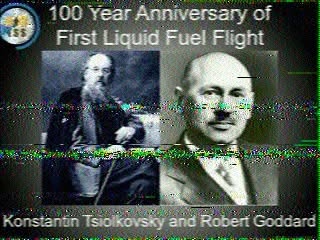
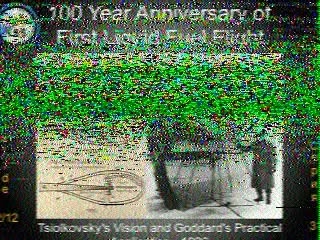
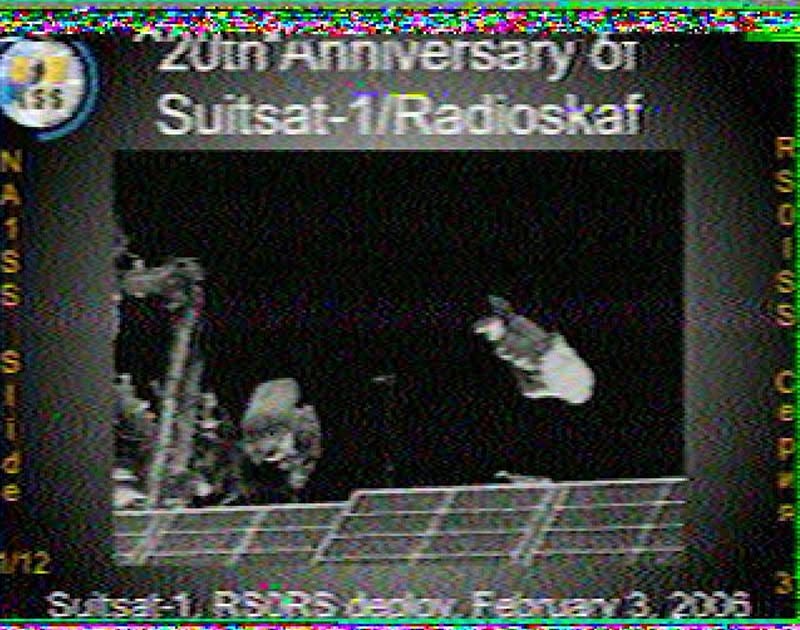
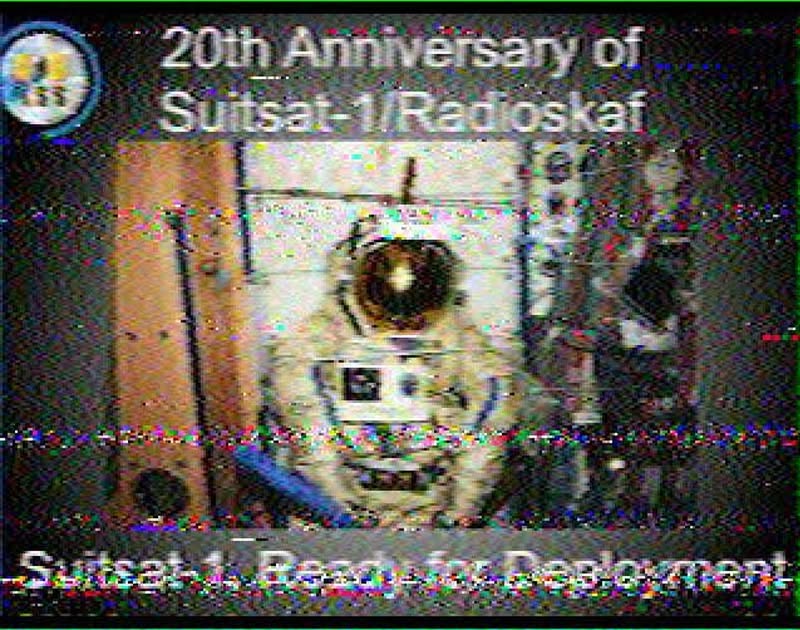
The images came through surprisingly clean. I captured several of the commemorative pictures honoring Gagarin, the Space Shuttle era, and the historic rocket launches. Seeing those historic space moments transmitted live from orbit was awesome. One image even decoded almost perfectly, proof that the combination of the UV-Pro’s sensitivity and the app’s Doppler handling worked well. I submitted my receptions to the official ARISS SSTV Gallery. It’s always fun to see your call listed alongside stations from all over the world. Lessons Learned and Thoughts This event reinforced that you don’t need a massive station to participate in ARISS SSTV. A modern handheld like the UV-Pro paired with its app makes satellite reception more accessible than ever. The automatic Doppler correction was a genuine advantage — it let me enjoy the passes instead of fighting the frequency drift. If you’re thinking about trying SSTV from the ISS, I highly recommend giving a capable dual-band HT a shot, especially one with good satellite features. Start simple, chase a few passes, and you’ll be surprised what you can decode. A big thank you to the ARISS team for putting on another fantastic series. These events keep the magic of amateur radio in space alive for all of us on the ground.
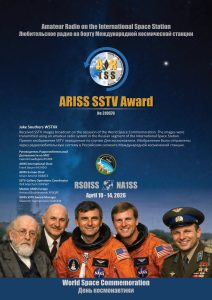
For participating and submitting my images I received a ARISS SSTV Award.
Amateur Radio on the International Space Station (ARISS) is a cooperative venture of international amateur radio societies and the space agencies that support the International Space Station (ISS). The primary goal of ARISS is to promote exploration of science, technology, engineering, the arts, and mathematics topics. ARISS does this by organizing scheduled contacts via amateur radio between crew members aboard the ISS and students. Before and during these radio contacts, students, educators, parents, and communities take part in hands-on learning activities tied to space, space technologies, and amateur radio
73,
W5TXX